
Asking price is easy to compare, but it rarely tells the whole story. Two properties with similar prices can have very different ownership costs, locations, maintenance needs and investment characteristics.
Begin by creating the same comparison categories for every property. Useful categories include purchase price, estimated closing costs, condition, immediate repairs, ongoing expenses, location, transport, amenities, neighborhood quality, property layout and future suitability.
Condition can materially change the real cost of a purchase. A lower-priced property that requires significant repairs may ultimately demand more capital than a better-maintained alternative. Record known issues and keep estimates separate from confirmed quotations.
Location should also be compared consistently. Consider commute or transport access, nearby services, schools where relevant, noise, surrounding land uses and future development. Avoid relying only on a general impression of the neighborhood.
For investment properties, add rental income assumptions, vacancy, operating expenses, financing, cash flow and yield calculations. Use the same assumptions across properties so that the comparison remains meaningful.
It can also help to distinguish objective information from personal priorities. One buyer may value walkability while another prioritizes space, parking or rental demand. Assigning importance to your own criteria can make trade-offs easier to see.
A useful comparison does not automatically choose a property for you. It creates a consistent framework so you can see where each option is stronger, weaker or still requires investigation.
Property Education
How to Compare Properties Beyond the Asking Price
The cheapest property is not always the strongest option. Compare condition, location, ownership costs, risks and long-term suitability.
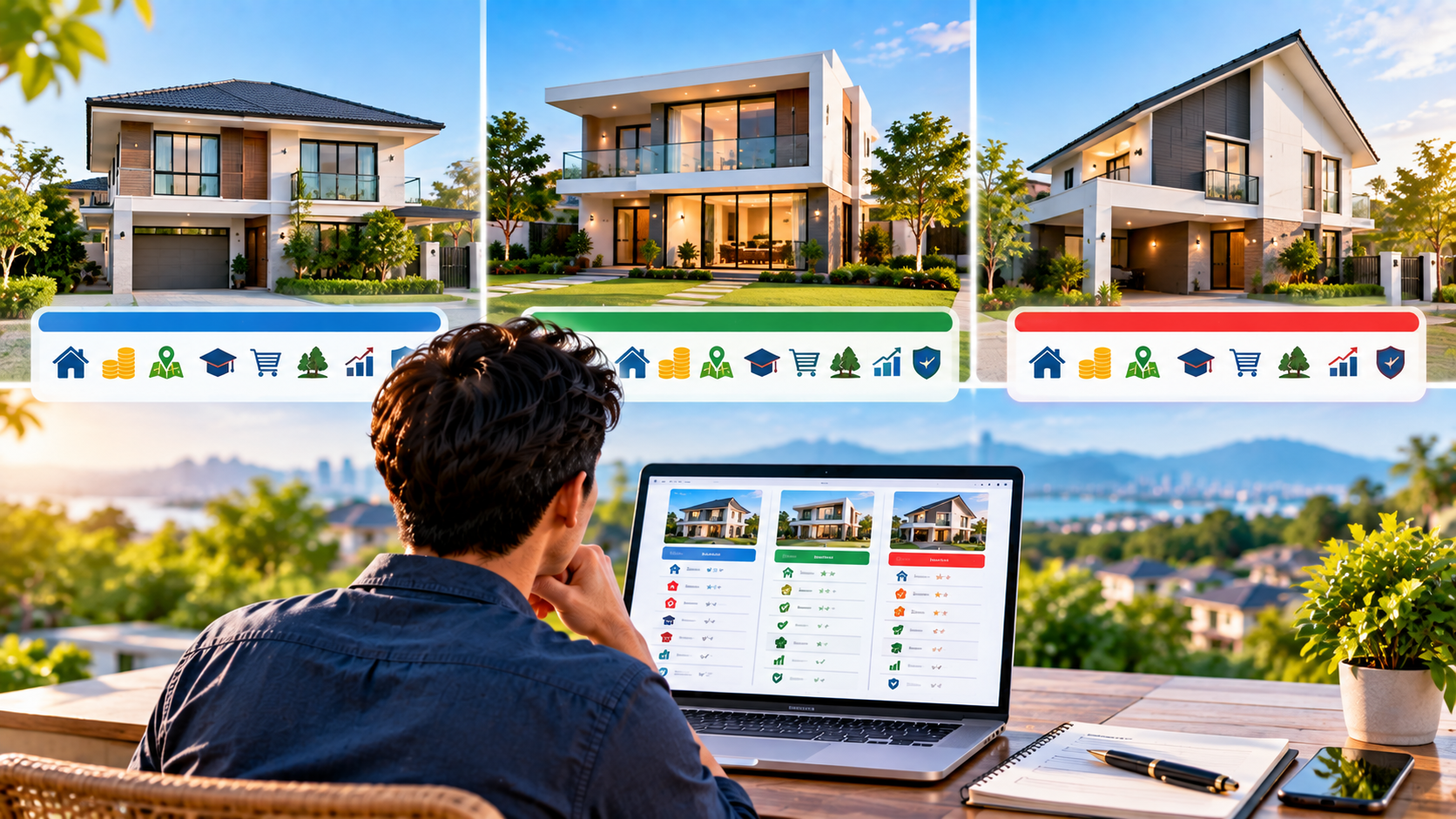
Turn research into a repeatable process.
Explore ToolsExplore practical property checklists, planners and spreadsheets.